Summary
Digital dentures are the future of dental prosthetics, replacing traditional moulds with precise 3D digital scans and AI-driven designs. 3D printing technology enables modern dentures to provide a superior, customised fit, enhanced durability, and faster fabrication times than traditional denture manufacturing techniques.
–
Are you still wearing traditional dentures? You know, the kind that’s clunky and ill-fitting, the ones you place in a glass of water by your nightstand? If you said yes, then what would you say if we told you that those dentures are already obsolete?
The days of dealing with loose, poorly-fitting dentures are over. Enter the era of digital dentures: comfortable, better-fitting, with a better bite and better aesthetics. Digital dentures offer greater personalisation than conventional options [1].
Episode 9 and Episode 13 of the Mouth Off Dental Podcast take you on a deep dive into how far denture technology has progressed in Australia. Host Elias Sara, head prosthetist and dental technician at Aesthetic Dental Clinic, and the Camden clinic team are industry experts actively shaping the future of dental technology in the country.
From Goop to Scans: The End of Traditional Impressions
Do you remember how uncomfortable your initial denture appointment was? Your dentist probably made you bite down on a blob of goop to get an impression. They also had to constantly check whether they had the correct tooth colour or the correct bite.
These issues are a thing of the past with digital dentures enabled by digital mapping techniques.
Modern Intraoral Scanners
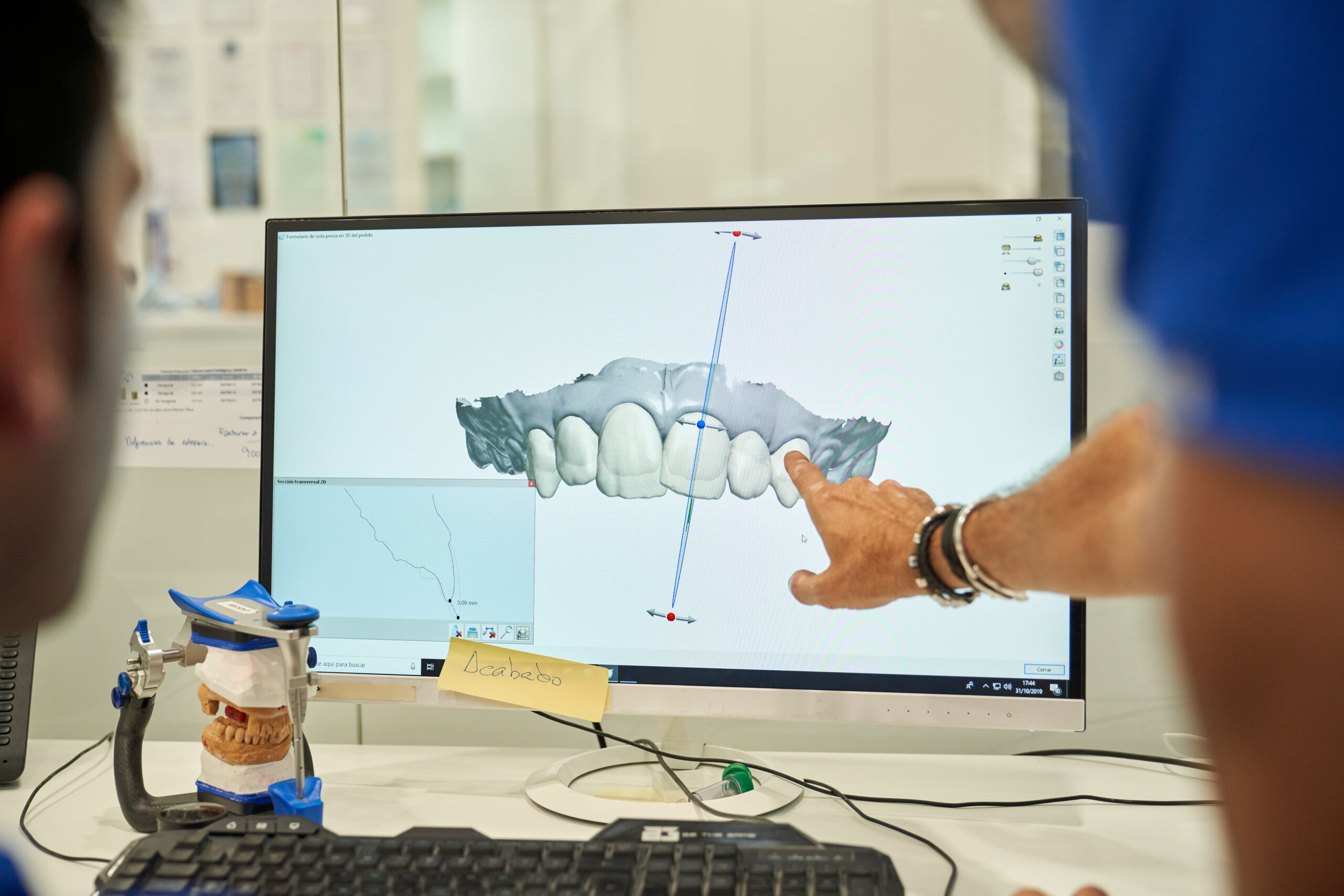
Intraoral scanners are the latest in optical technology, digitally capturing precise 3D images of the oral cavity, such as the teeth and surrounding tissues. Scans of the patient’s teeth are usually ready in just minutes, providing an accurate, digitised print of their gums and bite.
Intraoral scanners use advanced optics to capture high-resolution images of the oral cavity. A dental prosthetist receives real-time feedback in the form of live images on their computer screens. As the device moves within the oral cavity, it continuously captures and processes these images [2].
Modern intraoral scanners are also portable and wireless, allowing users to move freely during scanning.
The 3D Printing Revolution & AI in Dentistry
Once the intraoral scanner scans are ready, they are fed into AI-assisted design software to create the perfect digital dentures. By crafting the perfect arch, tooth shape, and bite alignment, the technician can produce dentures that ensure the best fit and complement the patient’s facial structure.
3D Printing for Effortless Fabrication
Traditional acrylic denture fabrication is usually made using a two-part gypsum mould. This is created by forming wax trial dentures with the teeth in place, then removing the wax and treating the mould with an alginate sealing agent [2]. This process is not just time-consuming but also labour-intensive.
3D printing in dentistry has changed how dentures are made, enabling clinics to precisely fabricate them from advanced, durable, biocompatible resins. The result is highly accurate and consistent, which is difficult to achieve with traditional manual fabrication methods.
Why Digital Dentures Fit Better and Last Longer
Digital dentures offer the best fit, allowing you to talk, eat, and smile with confidence. These dentures last longer, making them a great investment.
Superior Fit
Digital dentures are produced from digital impressions; thus, they are precise and perfect straight from the 3D printer, with minimal to no adjustments needed. The fit is superb, so there’s no movement when you talk, eat, or smile. You can say goodbye to denture break-ins, sore spots, or using messy denture adhesives with digital dentures.
Easy Replacements
Your exact oral dimensions are securely stored in a digital file; thus, if you lose or break your dentures, they can be quickly reprinted to the same perfect fit. There’s no need to wait too long to get your dentures reproduced, and you don’t need to get a new scan either.
The Camden Clinic Advantage: Our In-House Laboratory
What sets our Camden clinic apart from standard dental practices is our in-house laboratory. A standard clinic takes weeks to deliver dentures because it outsources manufacturing to commercial laboratories or external suppliers. They leave patients waiting too long, and in case adjustments need to be made, more weeks of waiting and wishing the fit is right when it arrives.
Our Camden clinic features a state-of-the-art in-house laboratory, allowing us to fabricate dentures on-site. Our patients receive their digital dentures faster and, if adjustments are needed, receive the completed dentures sooner. We apply unmatched quality control, delivering precise digital prosthetics to all our Camden clients.
Frequently Asked Questions
What is the difference between traditional and digital dentures?
Traditional dentures are made using physical moulds and manual labour. Digital dentures are created using high-tech 3D intraoral scans and fabricated using precision 3D printers for a superior, customised fit.
Are 3D printed dentures more comfortable?
Yes, 3D-printed dentures are more comfortable because they are digitally mapped. They conform perfectly to the unique shape of your gums, which greatly reduces friction, sore spots, and movement.
How long does it take to get digital dentures?
Because we operate an in-house laboratory at our Camden clinic, we can design, print, and fit new dentures in a fraction of the time required for traditional dentures.
What happens if I break my digital denture?
We keep an exact dental blueprint of your dentures on file, so if you break or lose your digital dentures, we can print an exact replica without needing to take new scans.
Tune In & Transform Your Smile
Don’t get stuck in the past. Digital dentures are the future of dentures, with a great fit, good bite, and superb comfort. Learn more reasons why digital dentures are awesome by listening to the deep dives in Episodes 9 and 13 of the Mouth Off Dental Podcast.
Fascinated by the future of dental technology? Tune into Episodes 9 and 13 of the Mouth Off Dental Podcast.
References
[1] International Dental Arts – 8 Things You Need to Know About Digital Dentures
[2] National Library of Medicine – Intraoral Scanners: Mechanism, Applications, Advantages, and Limitations